By Robert J. Fischer with the Robert J. Fischer Team at Keller Williams Realty
Early June showing activity points to renewed summer momentum across the Austin metro housing market.
The Austin metro housing market appears to be re-engaging after a modest May pause.
After a strong start to 2026, activity slowed slightly during parts of May as buyers responded to higher interest rates, elevated fuel costs, and broader economic uncertainty. But early June microdata suggests buyers are beginning to move again.
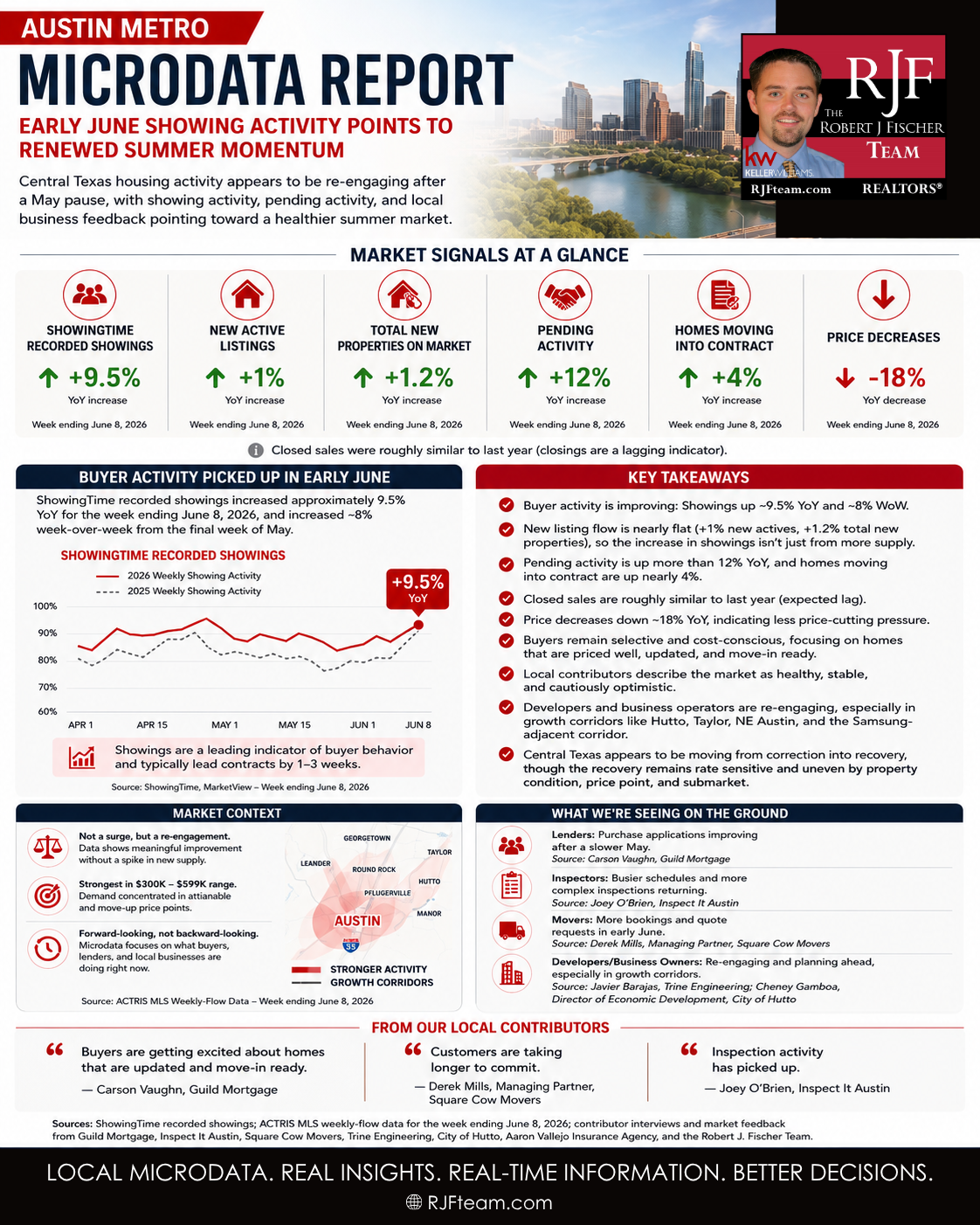
ShowingTime data across Williamson County and Travis County ZIP codes reviewed by the Robert J. Fischer Team showed that recorded showings were up approximately 9.5% year-over-year for the week ending June 8, 2026.
That increase is especially notable because new active listings were up only about 1% year-over-year during the same week. In other words, the increase in showings does not appear to be driven simply by a major increase in new supply.
MLS weekly-flow data also showed pending activity up more than 12% year-over-year, while price decreases were down approximately 18% compared to the same week last year.
The takeaway: the market is not suddenly booming, but it is clearly re-engaging.
Key Takeaways
- ShowingTime recorded showings were up approximately 9.5% year-over-year for the week ending June 8, 2026.
- New active listings were up only about 1% year-over-year, suggesting the showing increase was not simply caused by a surge in new supply.
- Pending activity was up more than 12% year-over-year.
- Homes moving into contract were up nearly 4%.
- Price decreases were down approximately 18% year-over-year.
- Buyers remain selective and cost-conscious, but they are still active when homes are priced well, updated, and move-in ready.
- Local contributors continue to describe the market as healthy, stable, and cautiously optimistic.
- Developers and business operators are beginning to re-engage, especially in growth corridors such as Hutto, Taylor, northeast Austin, and the broader Samsung-adjacent corridor.
Showing Activity Picked Up in Early June
The most compelling microdata this month came from ShowingTime data across Williamson County and Travis County ZIP codes.
For the week ending June 8, 2026, ShowingTime recorded showings increased approximately 9.5% compared to the same week last year. Even more important, showing activity increased approximately 8% week-over-week from the final week of May into the first week of June.
This supports what many local professionals have been feeling in real time: May was slower than the first part of the year, but early June is beginning to feel more active again.
The strongest showing activity remained concentrated in the $300,000 to $599,000 price ranges. That matters because those segments include many first-time buyers, move-up buyers, relocation buyers, and affordability-sensitive buyers.
MLS Weekly Flow Data Confirms the Showing Signal
The ShowingTime data becomes more meaningful when compared against MLS weekly-flow data.
For the week ending June 8, 2026, new active listings were up only about 1% year-over-year, and total new properties on market were up about 1.2%. If showing activity had risen only because significantly more homes were listed, that would tell a different story.
But that does not appear to be what happened.
Showing activity was up about 9.5%, while new listing flow was nearly flat. Pending activity was up more than 12%, and homes moving into contract were up nearly 4%.
That points to improving buyer engagement rather than activity caused only by increased supply.
The Market Paused in May, But Did Not Pull Back Broadly
The broader theme from local contributors this month is consistent: May felt slower than the first part of 2026, but the market still feels healthier than it did during the previous few years.
The first three to four months of the year showed strong signs of pent-up demand returning. When interest rates were lower earlier in the year, buyers responded. As rates moved higher and fuel costs rose, buyer urgency cooled. That created a pause, especially in the beginning and middle of May.
However, early June activity suggests the market is beginning to re-engage.
What Is Selling and What Is Sitting
The market is not rewarding every listing equally.
Move-in ready homes, updated homes, well-priced homes, and homes with strong presentation are receiving the most attention. Buyers are willing to act when they feel the home justifies the payment.
Homes that need significant updating are sitting longer unless they are priced aggressively enough to compensate for the needed work, time, and effort.
Carson Vaughn with Guild Mortgage described the market as balanced in terms of supply and demand. He said buyers are getting excited about homes that are updated and move-in ready, while homes that need work are sitting longer and experiencing price reductions.
Moving Activity Shows Consumers Are Still Making Life Decisions
Derek Mills, Managing Partner of Square Cow Movers, said May finished relatively similar to last year, with revenue up approximately 1% to 2%. That was slower than the stronger growth seen earlier in the spring, but still reflects a healthy market.
Square Cow is expecting June and July to remain active, consistent with normal seasonal patterns. Current bookings are tracking roughly in line with last year’s completed moves, while lead volume is running about 10% higher.
One of the most interesting points from Mills was that customers are taking longer to commit. Square Cow is booking a higher percentage of moves within a week of the actual move date than it has historically.
That aligns with the broader market theme. Consumers are not absent. They are more careful.
Inspection Activity Is Also Picking Up
Joey O’Brien with Inspect It Austin also reported that inspection activity has picked up.
Inspection activity is another strong microdata indicator because inspections typically occur after a buyer has already made an offer and entered into contract. If showing activity is the first sign of buyer engagement, inspection activity is one of the next signs that showings are beginning to convert into real transactions.
Insurance Costs Remain a Real Affordability Factor
Aaron Vallejo Insurance Agency is also seeing more activity in the insurance market, along with a major focus from consumers on saving money and understanding coverage options.
Insurance costs are now a meaningful part of the affordability equation for many buyers, especially first-time and second-time homebuyers. Even when a buyer qualifies on purchase price and interest rate, rising insurance premiums can affect debt-to-income ratios and monthly comfort levels.
Development Activity: Stable, Cautious, and Re-Engaging
Javier Barajas with Trine Engineering said development-related activity has been steady over the past 30 days. Clients are moving forward with projects, but no one is rushing for permits.
He described the market as stable and cautiously optimistic. Some developers are pushing forward, while others are watching interest rates, oil prices, and broader economic signals before committing more aggressively.
Hutto: A Growth Corridor Worth Watching
One of the most important local growth stories this month is Hutto.
Cheney Gamboa, Director of Economic Development for the City of Hutto, described Hutto as pro-business and pro-growth, with an emphasis on serving the people who live and work there. She noted that the city is committed to one of the fastest commercial permit review timelines in the Austin region, with a goal of reviewing commercial permits within 10 business days.
Gamboa said industrial space is leasing up in parts of Hutto, with some developments already considering second phases sooner than expected because of leasing momentum.
She also identified several needs and opportunities in the market, including additional grocery options, hotel rooms, meeting space, sit-down restaurants, shopping, retail, entertainment, recreation, storage, flex, and retail space.
Northeast Growth: Hutto, Taylor, Samsung, and the Next Development Cycle
The northeast corridor remains one of the most important areas to watch in Central Texas.
Hutto, Taylor, and surrounding communities benefit from a combination of relative affordability, transportation access, land availability, and major employment drivers. Samsung’s continued presence and expansion in nearby Taylor has created a long-term growth story that is still unfolding.
Major employer activity from Samsung, Tesla, SpaceX-related activity, and other advanced manufacturing and technology investments continues to support the long-term case for housing, industrial, retail, and mixed-use development across the region.
Austin’s Correction Has Already Happened
One reason this moment feels different is that Central Texas has already experienced a major correction.
From the pandemic boom through the peak, prices increased quickly. After that, the region absorbed a substantial correction as interest rates rose, affordability tightened, and buyer demand cooled.
Now the market appears to be moving into a different phase.
The market is not back to 2021. It should not be. But the worst of the correction appears to be behind us in many segments.
A Margin Market, But Also an Emerging Opportunity Market
This is still a margin market.
Buyers are sensitive to monthly payment. Sellers need to price correctly. Builders need to use incentives strategically. Developers are watching rates and construction costs. Insurance matters. Fuel costs matter. Concessions matter. Condition matters.
But that does not mean the market is weak.
It means buyers and businesses are being selective.
What This Means for Buyers
For buyers, the market still offers opportunity, but preparation matters.
There is more inventory than during the frenzied market, and buyers often have more room to negotiate, especially on homes that need updates or have been sitting. Seller concessions remain common in some price segments, particularly where affordability is tight.
But the best homes are still attracting attention.
What This Means for Sellers
For sellers, condition, upgrades, and pricing strategy are more important than ever.
The market is improving, but buyers are not ignoring value. Homes that are clean, updated, staged well, priced correctly, and marketed professionally are performing better. Homes that need work may still sell, but they usually need to be priced with that condition in mind.
What This Means for Developers and Investors
For developers and investors, the message is more forward-looking.
Central Texas has corrected, but the long-term fundamentals remain strong. The region still benefits from employment growth, business expansion, population movement, infrastructure investment, and major employer influence.
The northeast corridor, especially Hutto and Taylor, remains one of the clearest areas to watch.
Outlook: Re-Engagement Heading Into Summer
The June microdata does not suggest a runaway market. It suggests a healthier, more balanced, re-engaging market.
The most important signal this month is that buyer activity picked up in early June while new listing flow remained roughly similar to last year. That is a stronger signal than showings alone.
The market slightly paused in May. But early June ShowingTime data, MLS pending activity, inspection feedback, moving activity, and development conversations all point to renewed momentum.
Buyers are still cost-conscious. Sellers still need to be realistic. Developers are still getting ready. And the market is moving.
Central Texas appears to be moving from correction toward cautious recovery.
Media Use: Media outlets and industry professionals may reference, quote, or republish insights from the Austin Metro Real Estate Microdata Report series with attribution to Robert J Fischer and a backlink to the original report page.
Contributors and Sources: ShowingTime data and MLS weekly-flow data reviewed by the Robert J. Fischer Team; Carson Vaughn with Guild Mortgage; Derek Mills with Square Cow Movers; Joey O’Brien with Inspect It Austin; Aaron Vallejo Insurance Agency; Javier Barajas with Trine Engineering; Cheney Gamboa with the City of Hutto; Community Impact reporting; and local market feedback from Central Texas real estate and business professionals.
